How a dental clinic grows past its owner dentist
Most small dental clinics stall because new patient calls, coverage questions and recall all wait for a front desk that is also chairside. Write your answers down once, let AI handle the repeat part on servers you control, and keep every clinical decision with a dentist.

Toronto, Ontario · 2 min read · Nov 26, 2026
40%
of dental offices with staff have fewer than five
100 dental offices. 40 have fewer than five staff.
In Canada, about 4 in 10 dental offices with employees have fewer than five people.
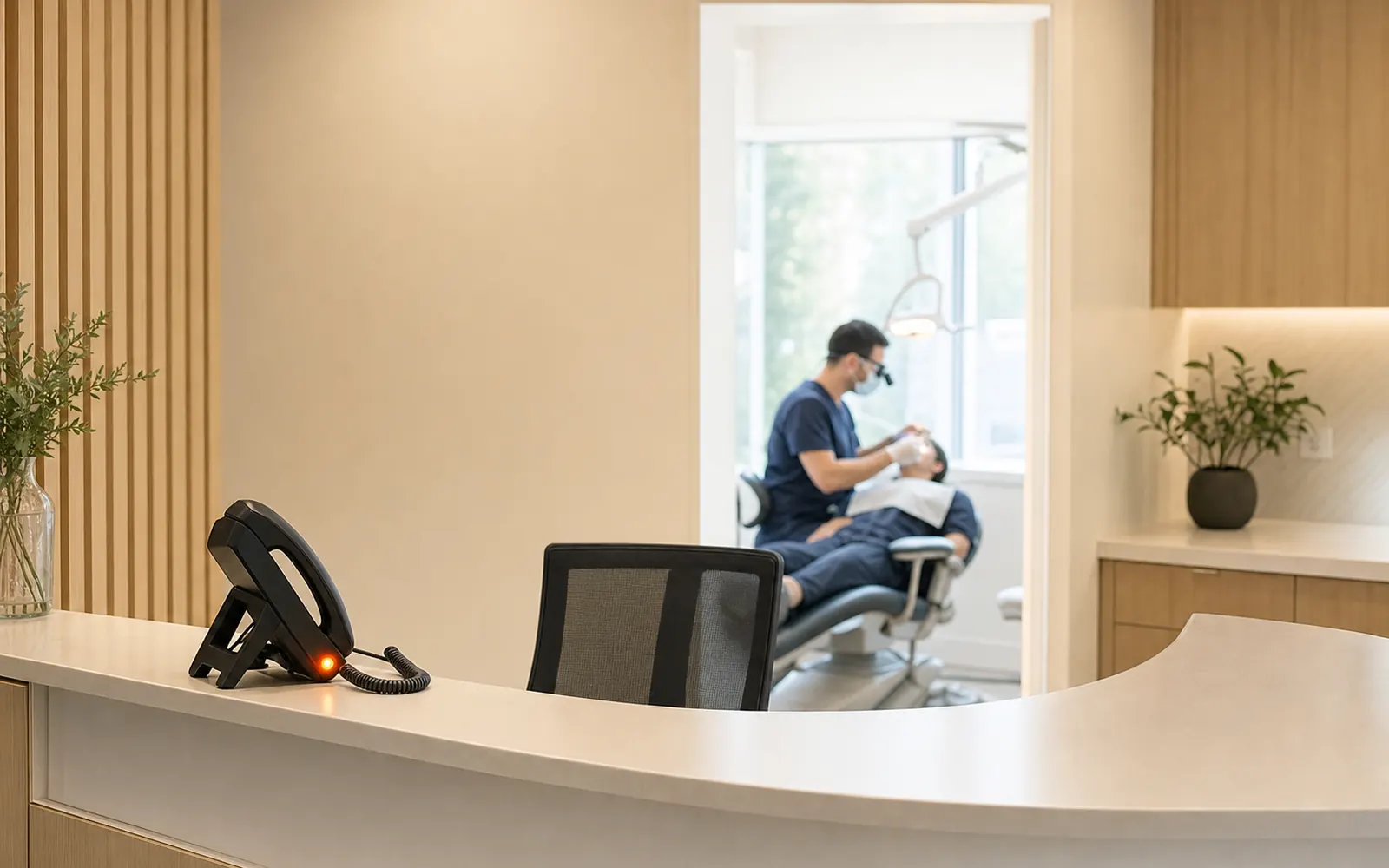
In a clinic that size, the person at the front desk also assists chairside. The dentist is with a patient most of the day.
So when the phone rings during a procedure, it rings out. The new patient calls the next clinic on the list.
- Canadians can get care under the Canadian Dental Care Plan
- 6.5M+
- Health Canada, April 2026
- of dental offices with staff have fewer than five
- 40%
- Statistics Canada, 2025
- US dentists worried about hiring and keeping staff
- 3 in 5
- ADA Health Policy Institute, 2025
More patients. The same front desk.
More than 6.5 million people can now get care under the Canadian Dental Care Plan. Many of them are new to a dentist, and they call with questions first.
Am I covered? Do you take the plan? What will I pay?
Every one of those calls lands on the same small team. And staff are hard to find: in the US, 3 in 5 dentists said they were worried about hiring and keeping staff.
- Dentistry
- Dentistry Still the reason patients come
- New patients Calls, forms, the first visit
- Coverage "Do you take the plan?"
- Recall Cleanings due, reminders sent
- Treatment plans Accepted, then never booked
- Her team Every question comes to her
Meet Angel
Angel worked as an associate at a busy clinic. Reception, scheduling and billing had their own people.
Then she bought her own practice with two staff. She still does the dentistry. Now she also runs five other jobs, mostly after the last patient leaves.

After the last patient
- Voicemails to call back
- Coverage questions to answer
- Recalls due this week
- Treatment plans not yet booked
After the last patient
The clinic closes at five. Angel stays.
She calls back the people who rang during the day, answers coverage questions and works through recall.
None of it is dentistry. All of it waits for her.
-
A toothache call at 7 am
Voicemail. They call the next clinic.
Answered in her words. An emergency slot offered.
-
"Do you take the plan?"
Waits for the front desk.
Answered the way her clinic answers it.
-
A cancellation at 9 am
An empty chair at 10.
The waitlist offered the slot.
-
A treatment plan not booked
Forgotten until the next cleaning.
A follow-up in her words. Booked or noted.
-
Recall due
Done when someone has time.
Reminded, rebooked, logged.
Five moments, before and after
Every one of these waits for Angel or her front desk today. None of them needs her clinical judgment every time. They need her answers written down once.
Anything clinical, urgent or new still goes to her team.
Transparency
It says it is AI
Patients know when they are talking to an assistant, not a person.
Privacy
Patient data stays yours
On servers you control, in Canada if you want, under PHIPA.
Consent
No other uses
Patient information is not used to train anything or shared.
Responsibility
You stay the dentist
It answers the front desk questions. Clinical judgment stays with you.
What the RCDSO expects
In September 2025 the Royal College of Dental Surgeons of Ontario published guidance on AI in dentistry. It sets no new rules. Your existing duties still apply.
It asks you to tell people when they are talking to AI, to know where patient data is stored, and not to let patient information be used for anything else without express consent. You stay responsible for the care you give.
This guide is not legal or regulatory advice. Check your own obligations with the RCDSO.
- 1
Write it down
Your services, your hours, how coverage works at your clinic, what counts as urgent, what you never say on a call.
- 2
Build it
AI that answers calls and forms your way and books into your schedule.
- 3
Review it
Read every call in a short daily brief. Fix an answer once and it stays fixed.
How to start
Start with the new patient call. It is the same conversation dozens of times a month, and it is where most clinics lose patients.
Then coverage questions, then recall and unbooked treatment. Each one is written once, then reviewed.
Key Man Score · 10 questions
Find what runs on you.
The Key Man Score shows how much of your clinic depends on you being there.
Starts with a free 2-minute check. Nothing is sent anywhere.
Sources
- Statistics Canada, special tabulation for offices of dentists (NAICS 6212), 2025, published in Canadian Industry Statistics (Innovation, Science and Economic Development Canada): 39.7% of employer establishments have fewer than five employees.
- Health Canada, More than 6.5 million Canadians can now receive services under the Canadian Dental Care Plan (April 2026).
- American Dental Association Health Policy Institute, Economic Outlook and Emerging Issues in Dentistry (Q4 2024 polling), as reported by ADA News (2025): about 3 in 5 dentists are worried about recruiting and retaining staff.
- Royal College of Dental Surgeons of Ontario, Artificial Intelligence in Dentistry (guidance, effective September 18, 2025), sections 11, 15 and 16.